High Wisps or Low Grey: Reading Cloud Shapes
Reading cloud shapes helps you describe the sky clearly, distinguish high wisps from grey layers and make a useful field note without treating it as a forecast.
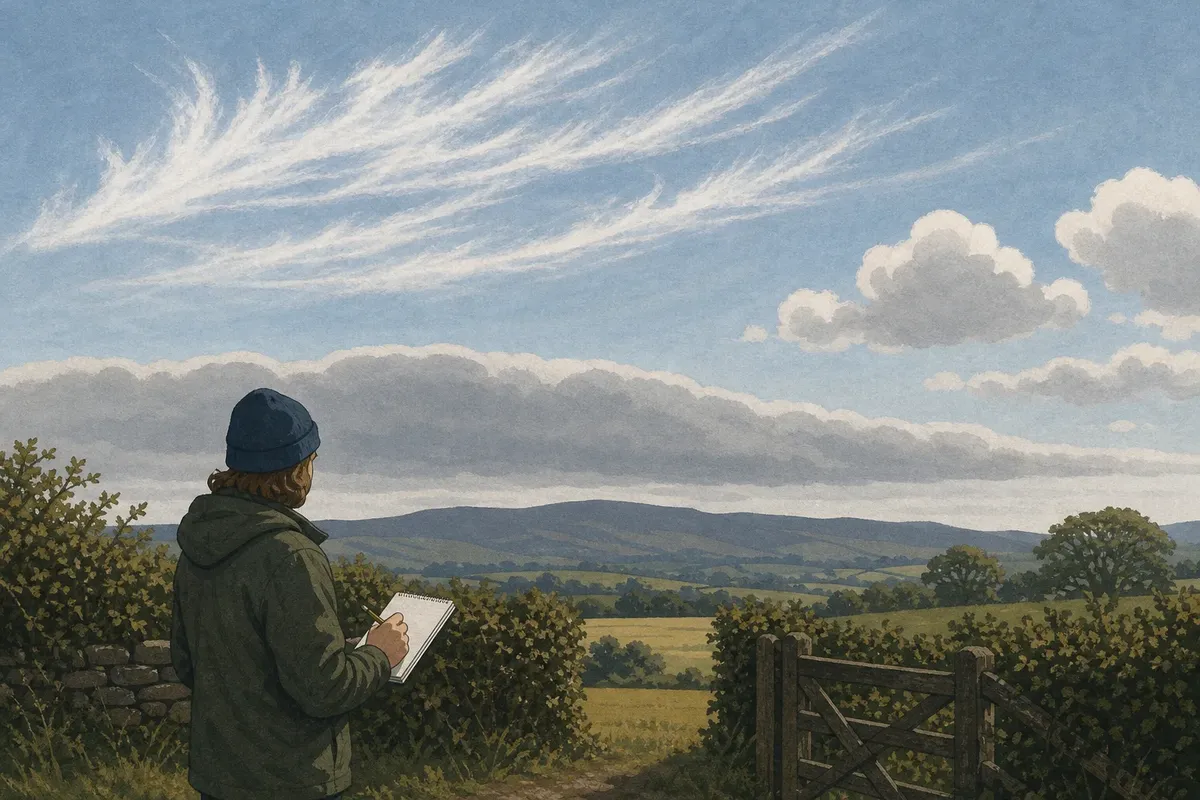
When you pause on a country lane, are the fine streaks high overhead, or is a grey layer sitting near the horizon? Reading cloud shapes begins with that distinction: describe what is visible, where it sits and how it is arranged, without turning the sky into a promise about what comes next.
Clouds overlap and look different as the light shifts. A useful note does not need every cloud name; it needs a clear description that another person could recognise from the same viewpoint.
What should a cloud description include?
Start with form and position, then add change only if it is clear. “Thin white streaks high overhead; a broad grey sheet above the western ridge” tells a reader more than “cloudy” and keeps the account close to what you can see.
- Form: If the shape is streaked, rounded, sheet-like or ragged, write that; if no form stands out, describe the overall cover instead.
- Position: If the cloud is high overhead, low above a ridge or spread across much of the sky, record its position; if the horizon is hidden, name a visible landmark or note that the view is blocked.
- Visibility: If edges are sharp, softened by haze or partly obscured by trees, include that detail; if the obstruction prevents a reliable description, leave the unseen area unlabelled.
- Change: If you can compare the same view and see a layer thicken, break apart or shift, record the change; if movement is uncertain, leave it out or write “seems to drift”.
- Uncertainty: If cloud, mist or distant land cannot be distinguished, state the ambiguity; if a second view does not settle it, keep the description tentative.
These details overlap less than they may seem: form describes shape, position locates it, and visibility records how clearly you can see it. Change and uncertainty belong in the note only when they add something useful.
How do high wisps differ from a grey sheet?
High wisps appear as fine, threadlike streaks with feathered edges. They may sit separately against blue sky or collect in a delicate veil, with open sky around them.
A grey sheet looks more continuous and even. Its edge may be hard to pick out, particularly when it covers a broad part of the sky. Notice whether blue sky or the sun’s outline shows through; if the light is hard to judge, simply record a grey layer.
Plain descriptions are often more reliable than formal names. Terms such as cirrus or stratus can help when the cloud’s form is clear, but they add little if height or structure is uncertain. A pale veil can also be difficult to distinguish from haze, so describe what you can see rather than forcing a label.
What do puffs, heaps and ragged fragments look like?
Rounded puffs have bulbous tops and flatter-looking bases. They may sit apart with blue gaps between them or crowd together until the gaps narrow. Note whether their outlines remain distinct or merge.
Towering heaps rise above ordinary rounded puffs and can develop a cauliflower-like outline. Vertical growth and a darker-looking base are visible features, though distance and shadow can exaggerate them. Describe the shape without treating it as a forecast.
Low ragged fragments are uneven pieces, often beneath a more uniform layer or near the horizon. From a sheltered lane, trees may hide the lower sky; a gap in a hedge or a field gate can give you a clearer view.
It is not worth assigning a formal name to every small patch. If several forms overlap, describe the most prominent one and mention the others only if they change the overall picture.
How can you describe cloud shapes from a rural route?
Choose an opening with a clear view of the sky, such as a field edge, an open bend or a gate beside a lane. Look across the whole sky, then focus on one part. Use a compass direction if you know it; otherwise, a landmark such as “over the ridge” or “above the church tower” is easier to check.
Say you stop at a gap in a hedge and see fine streaks overhead, a grey bank above distant hills and small rounded puffs to the east. You write, “High wisps across the centre; grey layer low over the western ridge; scattered puffs to the east.” Later, from the same opening, the bank appears broader. Keep the first entry unchanged and add a dated observation about its new extent. The resulting record shows what changed without recasting the earlier view as a prediction.
Cloud can be hard to separate from the landscape. A distant ridge may resemble a dark bank, while mist can soften a hill without forming a clear cloud edge. Compare the outline with a fixed landmark and check from another opening; if it remains ambiguous, write “possible cloud bank” or “haze over ridge”.
Which cloud questions help sharpen an observation?
What is the difference between high wisps and low ragged cloud?
High wisps look fine and streaked, with open sky around them. Low ragged cloud appears as uneven fragments near the landscape and may sit beneath a more continuous layer.
Does a grey cloud sheet mean rain is coming?
A grey sheet describes cloud cover, not a dependable forecast by itself. Record its extent and whether it thickens or breaks; for a practical weather decision, check a suitable local forecast.
How can I tell a cloud bank from a distant hill?
Compare its outline with a fixed landmark, then look again from another opening. If the shape stays aligned with the terrain, it may be land; if it changes independently, cloud is more plausible, though haze can still confuse the view.
Should I use cloud names in a field note?
Use a familiar name when the form is clear, and add ordinary descriptive words. If height or structure is uncertain, record the appearance and uncertainty rather than choosing a technical term for its own sake.
What should a careful sky note leave out?
A short note need not explain what the clouds “mean”. Avoid treating one shape as proof of rain, sunshine or wind, and do not infer conditions beyond the patch of sky you can see. A narrow lane may conceal important parts of the view.
Elaborate equipment is unnecessary for this kind of observation. A small notebook and pencil are enough; a phone photograph can help recall the arrangement, but it may flatten distance or alter the sky’s brightness. If you take a picture, keep the written description as the main record.
For reading cloud shapes, keep the note anchored to visible form, position and any clear change. At a familiar opening in a hedge, compare the clouds with the same landmarks; when edges are hidden, record that the view is incomplete rather than filling in what you cannot see.
Along the same path
Why a Hillside Looks Different from Above
Why a hillside looks different from above: understand how overhead contours, slope direction and light reveal…
The Hedge That Became a Boundary
Learn how hedgerows became boundaries and read their banks, trees and gaps for clues to the…