Who Is Speaking, and What Can They Know?
Assess a source’s access, method and independence to tell what its account can establish, where its limits lie and what to check next.
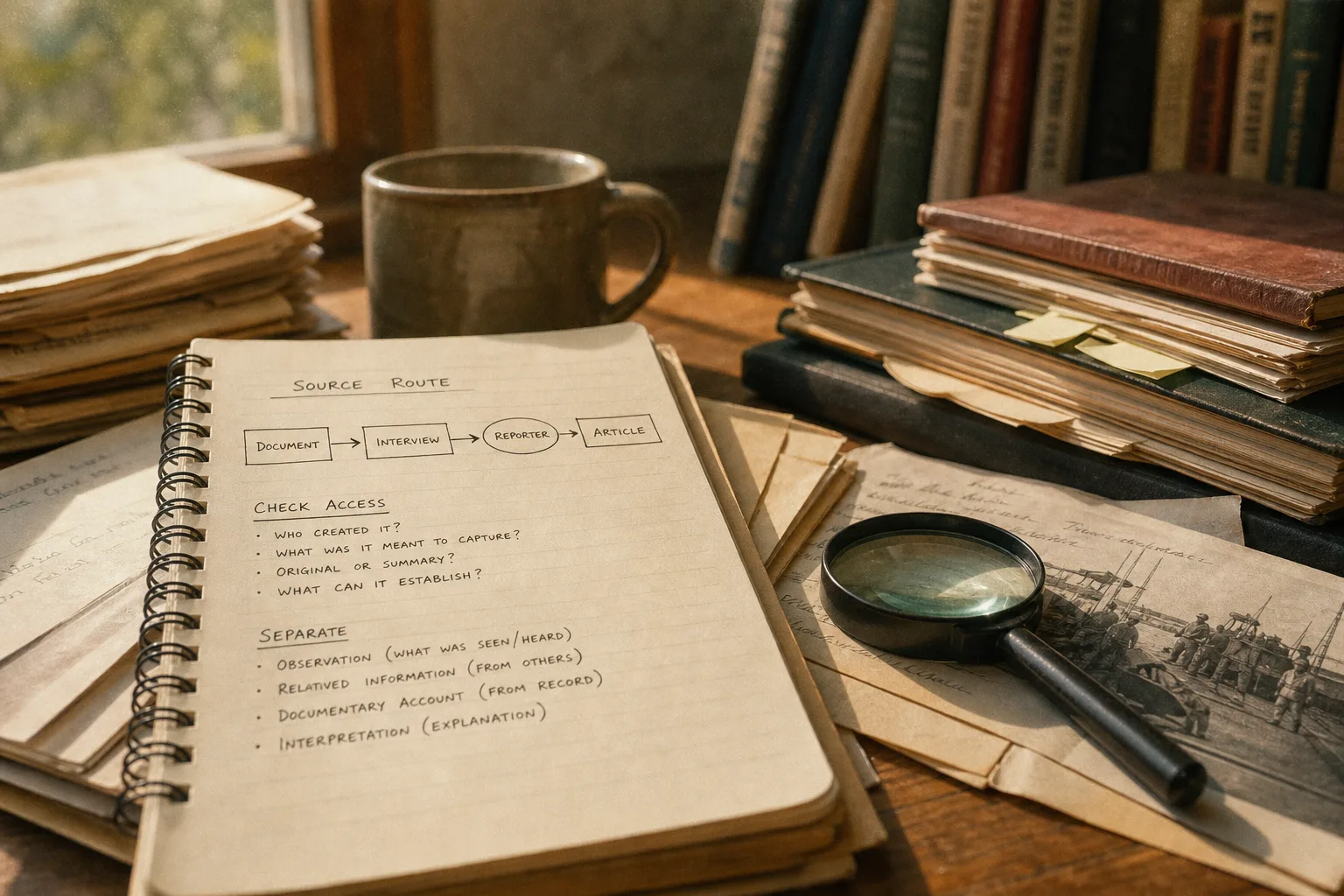
Who is speaking, and what could they know directly? To assess a source, trace how information reached them: through a document they handled, an event they witnessed, an interview they conducted or another account they repeated. A confident delivery does not reveal which route was used.
A surgeon may explain a procedure but have no access to a hospital’s accounts office. A resident may describe a sound from a flat without knowing its cause. A source is a bit like a labelled drawer: useful for finding what was put there, but not evidence that the whole filing cabinet is complete.
Separate observation from explanation
Start by sorting what the source says into distinct kinds of information. A person might report what they saw, relay a statement from someone else, describe a document or offer an interpretation of events.
These can sit side by side in one paragraph. Mark where the account moves from reporting material to explaining what it means; that change calls for a different check.
- Direct observation: What the source says they saw, heard, handled or recorded. If the account identifies a specific event they could perceive, use it for that observation; if it does not, look for a person who was present or a contemporaneous record.
- Relayed information: A claim attributed to another person, organisation or document. If the attribution is named and traceable, check that original route; if it is vague or absent, treat the claim as unverified and seek a clearer account.
- Documentary account: Information taken from a record, whether original or summarised. If the record’s creator and purpose are clear, assess what it was made to capture; if they are not, find the original or a description of its provenance.
- Interpretation: An explanation of what details mean or why something happened. If the source shows its reasoning and material, assess the connection; if it does not, seek an account that makes the reasoning visible.
- Untraceable account: Information with no usable indication of its origin. If no route can be identified, do not present it as established; look for a named source or leave the claim unconfirmed.
Check what the source could access
Access depends on place, time and task. A maintenance worker may know the condition of equipment they service, while a visitor may have seen only what was visible during a brief visit. Neither account settles what happened elsewhere or earlier.
Records also reflect the purpose for which they were made. Meeting minutes may capture agreed decisions while omitting informal discussion; a contract can state obligations without showing whether anyone carried them out. Ask who created the record, what it was meant to capture and whether you are reading the original or someone’s description.
Say a neighbour posts that they turned on a tap and found no water, then attributes the outage to council roadworks. The first detail is an observation; the cause is an explanation. If the post links to no council notice or water-provider statement, keep those claims separate and look for a source that can address the cause.
Follow the route behind a conclusion
When a source offers an explanation, look for the material and method behind it. Did they examine a document, interview people, compare records, analyse a dataset or rely on a colleague’s summary? The answer helps show what the account is actually based on.
Then inspect the move from that material to the conclusion. Someone who reviews a defined set of documents can describe those documents; extending a conclusion beyond them needs its own reasoning. A specialist’s title tells you about training, not whether they examined the evidence relevant to this particular claim.
Imagine a local reporter says a council changed a policy after reading three meeting minutes and interviewing one resident. The starting material is those minutes and that interview; the reporter’s next action is to connect them to the claim about why the policy changed. The observable output should be a traceable account of what each source says and how the reporter links them. If the minutes record the decision but not its reason, the sound conclusion is that the decision occurred, while the motive remains unresolved unless another source addresses it.
Count independent routes, not repeated wording
Several reports may repeat one origin. Two news stories drawing on the same press release provide two accounts of that release, not two independent routes to the underlying event. A social post that cites one of those stories adds no new source material.
For each account, note the origin it names and what it contributes: a separate record, a distinct witness, another interview or a method of its own. If every route leads back to the same statement, seek an original document or a source with separate access before treating agreement as corroboration.
Sources can also appear to disagree because they cover different times, locations or records. Compare what each actually examined before deciding whether the accounts conflict.
Read credentials and affiliations in context
Credentials can indicate training or experience, but they do not show that a person saw the relevant evidence or is speaking within their field. Match the claim to the knowledge it requires.
Imagine a climate scientist asked to explain a railway contract. Their expertise may help with climate analysis, while the contract calls for close reading of its text or knowledge of procurement. A relevant specialist or the original contract is a better route for that question.
An employer, client or campaign role can explain a source’s access or interest. Neither affiliation nor a possible stake settles accuracy. Use the context to decide what material or method needs checking, rather than dismissing the account automatically.
How do you check a source’s route?
How do you find the original source?
Follow citations, links and quoted attributions back to the earliest account you can access. If later reports all point to the same release or post, note that they share an origin rather than independently confirming it.
What can a document establish?
Identify who created it, what it was meant to record and whether you are seeing the original. A minute, contract or summary can support claims about its contents, but claims about events beyond the record need another source route.
How can you assess an expert’s method?
Check whether the claim falls within the expert’s relevant knowledge, then identify the material they examined and the reasoning they give. If either is unclear, seek an account that makes those parts visible.
What should you do when the source route is unclear?
Treat the account as a lead, not as settled support. Look for a named record, a direct witness or an explanation of how the claim was obtained; if no route can be traced, leave the claim unconfirmed.
Match the source to the question
For a claim about an observation, check who was present and what they could perceive. For an explanation, inspect the material and reasoning. For apparent agreement, trace each account far enough to see whether the sources reached their information independently.
The phrase who is speaking and what can they know is most useful when it leads to a specific next check: locate the original record, clarify the method or find an account with a separate route to the information. That keeps the judgement proportionate to what the source could actually access.