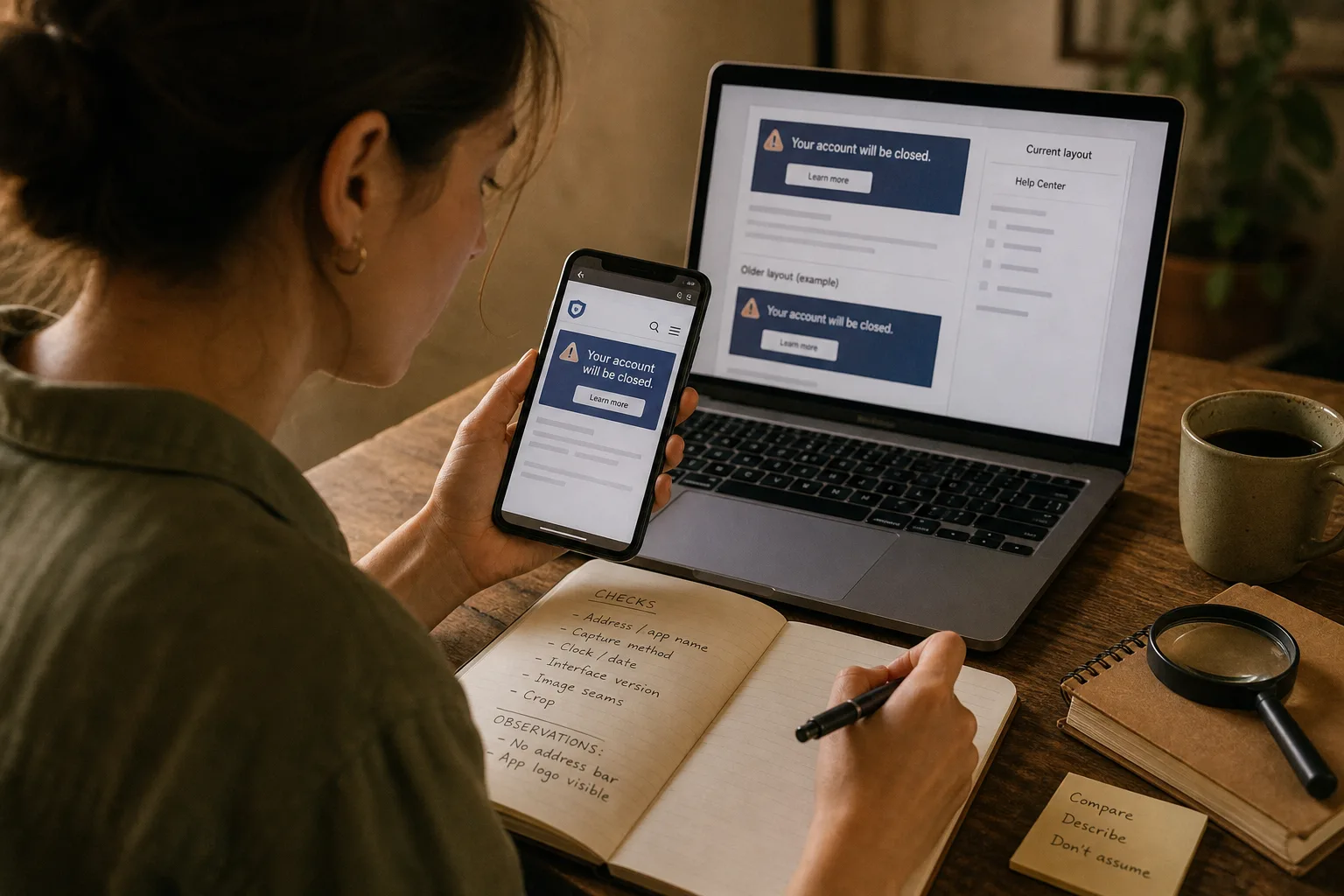
Before You Forward It: Keep the Claim Attached to Its Context
Keep context attached when forwarding a claim: make the source easy to open, separate your comment from the original, and help readers choose what to do next.
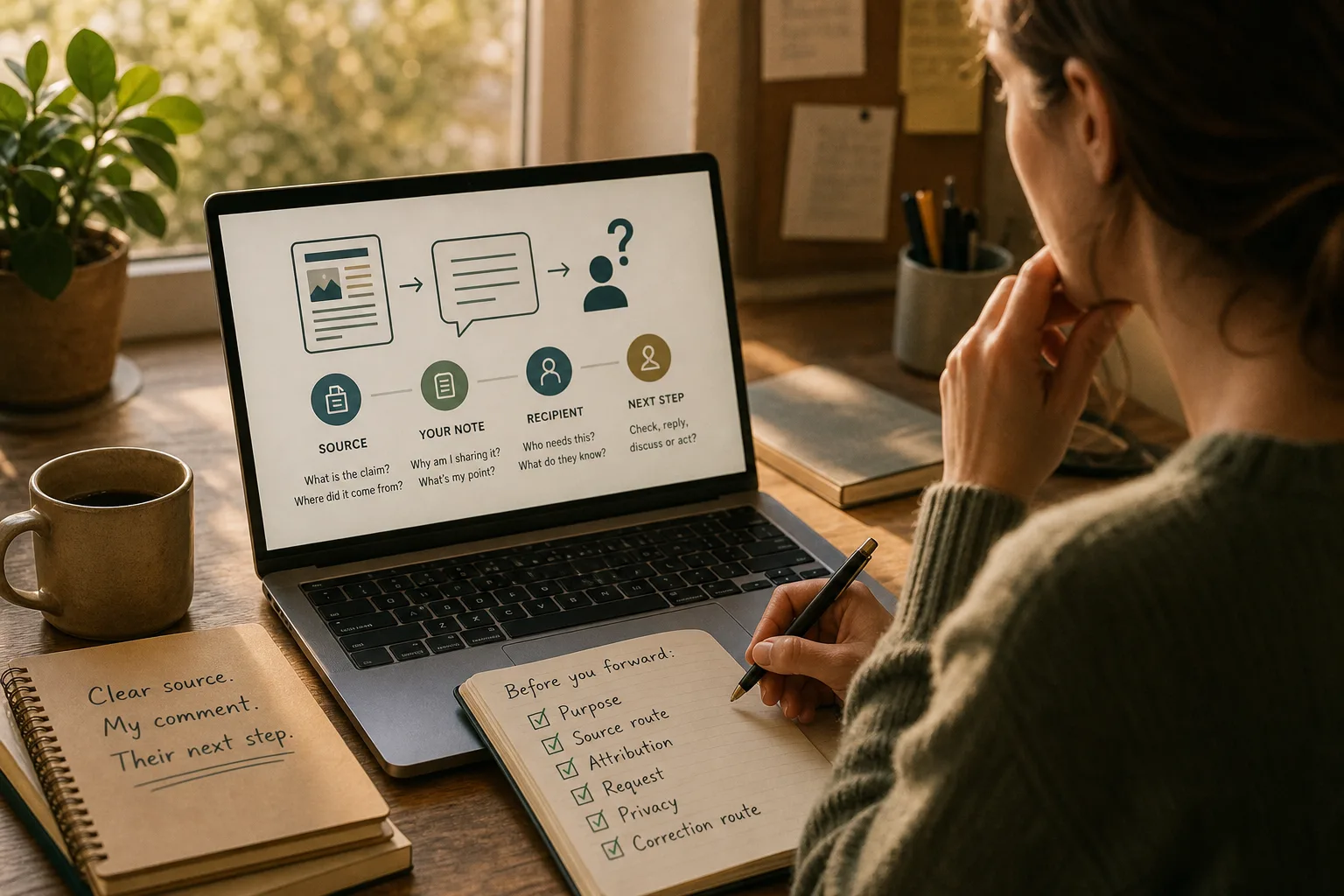
How do you forward a claim without making it sound like your own? A clear note separates the source’s words from your contribution and gives the recipient a useful next step. That small distinction matters most when a message might otherwise be passed on as an announcement or warning.
Treat a forward as a hand-off, not a verdict. The recipient should be able to find the material, tell what you are adding, and decide whether to reply, check something or leave it there.
Make the recipient’s next action clear
Say why you are sending the material before sharing a dramatic excerpt. Name the source in ordinary language and state what you want from the recipient, if anything.
- For awareness: Check whether the recipient can open the original. If they can, send the link with a brief reason; if they cannot, include the title and relevant passage or find an accessible source.
- For a decision: Check what detail the recipient needs. If the source contains it, point to that part; if it does not, ask a specific question rather than sending the item without explanation.
- For discussion: Check whether your view is visibly separate from the source. If it is, send the material with your comment introduced; if it is not, rewrite the note so nobody mistakes your opinion for a quotation.
- For a correction: Check which wording or detail you are querying. If you can identify it, quote the relevant passage and ask about that point; if you cannot, share the item and say what remains unclear.
- For an update: Check who saw the earlier message. If you know, send the correction to those people; if you do not, post it in the same channel where the original appeared.
- For a private exchange: Check whether the sender’s identity or exact words are necessary. If they are not, paraphrase without identifying details; if they are, ask permission or keep the exchange private.
A request for advice should not read like a public warning. Likewise, a message sent for discussion should not acquire the appearance of an official announcement simply because it travelled with a link.
Mark where the source ends and your comment begins
Use a verbal signpost: “The notice says…” for the source, followed by “I think…” or “Could you check…” for your contribution. The phrasing is plain, which is useful; ambiguity rarely improves with decoration.
For a quotation, identify the speaker or publication and link to the original where possible. Say when you are summarising, and if you have not seen the underlying material, make that clear rather than implying otherwise.
Keep your reaction tied to the purpose of the message. “I’m sending this because it mentions the school entrance” explains why it may matter. “This proves the school is unsafe” makes a broader claim that the material may not support.
Choose a format that lets the recipient check the source
A link suits public material the recipient can access. A short excerpt can help with a long document, while a screenshot is convenient but may leave no route back to the original.
- Link: Check that it opens the relevant page. If it does, add a sentence explaining why you sent it; if it does not, provide the document title or another usable route.
- Screenshot: Check whether it includes enough wording to make the point clear. If it does, add a link when available; if it crops out the speaker or surrounding exchange, send the fuller item instead.
- Quoted passage: Check the words against the source. If they match, identify the speaker and publication; if you are unsure, paraphrase and say that you are summarising.
- Voice note or clip: Check whether the recipient can hear the part needed to understand the point. If they can, identify the speaker; if the clip starts mid-conversation, provide the fuller recording or explain what is missing.
- Private message: Check whether the exact text is needed. If the substance is enough, paraphrase without personal details; if the wording matters, ask the sender before forwarding it.
A forwarded message is like a parcel with a label: the label cannot settle what is inside, but it helps stop the recipient mistaking it for something else. A clear subject line and one sentence of explanation often do the job.
What should you do when a claim needs a reply?
How do I ask someone to check a claim?
State what you have not established and ask a precise question, such as whether a named organisation issued a notice. If the recipient cannot check it, avoid circulating the claim as an urgent instruction.
How can I share a long document clearly?
Give its title and link, then identify the passage or section that prompted you to send it. If the whole document needs attention, say so; if one point matters, identify it without suggesting it represents every part.
What should I do when someone corrects a message?
Check whether the correction changes what you shared. If it does, send the corrected material to the same audience and say what changed; if it does not, explain the distinction rather than repeating the original claim without context.
Can I forward a message from a group chat?
Check whether the sender expected the message to stay in the group and whether it identifies someone. If forwarding could expose them, ask permission or paraphrase without those details; for an immediate safety concern, contact the appropriate organisation directly.
Check the hand-off before you send it
Read your message as if you had not seen the earlier conversation. Check its purpose, the route back to the source, the boundary between source and comment, the recipient’s task and any private details.
- Purpose: Check whether your note explains why you are sharing the item. If it does, send it to the intended person; if not, add a reason or hold it back.
- Source route: Check whether the recipient can open or identify the original. If they can, include the link or citation; if they cannot, provide a usable title or excerpt.
- Attribution: Check whether source and comment are distinct. If they are, send the note; if not, add attribution or rewrite your comment.
- Request: Check whether the recipient knows what response you want. If it is clear, send it; if not, ask a direct question or say no reply is needed.
- Privacy: Check for names, contact details or private exchanges the recipient does not need. If they are unnecessary, remove them; if that would still expose the sender, ask permission or do not forward.
- Correction route: Check where the earlier version appeared. If you know the audience, contact those people with the update; if not, post it in the original channel.
Say you receive a public notice about a temporary entrance change at a community centre and want a neighbour to check whether your meeting uses that entrance. The notice has a title, a working link and one relevant passage. You copy the title, open the link, and confirm that the passage names the side entrance. Then you send: “The centre’s notice says the side entrance will be unavailable during the building work; could you check whether our meeting uses it?” The neighbour can inspect the source and answer the practical question. If the link does not open, you can send the title and passage instead, making clear that the excerpt is not the whole notice.
For sharing claims, the useful habit is to build the hand-off around the next person’s task. Keep the source reachable, mark your own words, and make the request specific; when the message later needs a correction, that same clarity makes it easier to reach the right audience.